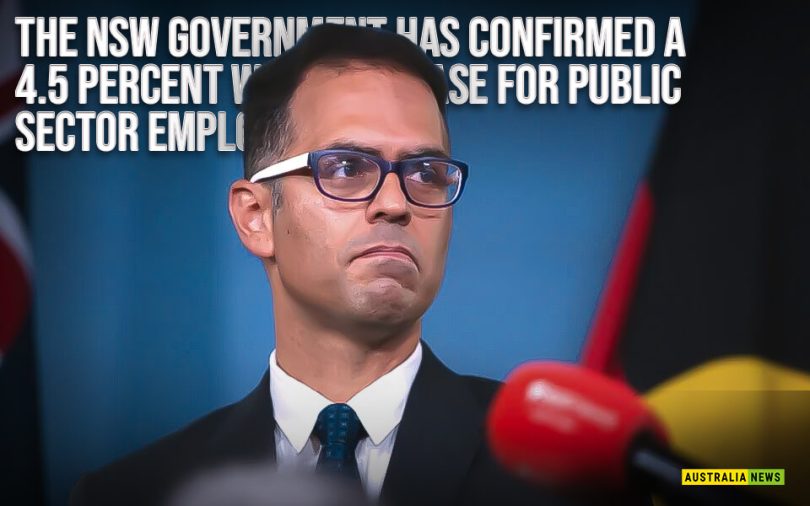

Tens of thousands of public sector workers in NSW may anticipate a 4.5% pay increase as the government moves to fulfill one of its key election pledges.
The pay hike will consist of a 4% rise in salaries and also a 0.5% increase for superannuation.
NSW Treasurer Daniel Mookhey mentioned it was the “highest pay rise awarded to public sector workers in a decade”.
He stated that the flat rate will be applied to all industry awards to maintain fairness; however, the Treasurer did not rule out extra pay considerations when productivity gains can be proven.
Before the salary increases are included in industry awards, unions will present the offer to their members before additional conversations and negotiations take place.
But the Treasurer said he expected not every industry group would be pleased.
While the 4% is still greater than the 3% wage cap enforced by the previous government, it would still be a real wage reduction given Australia’s 6.8% inflation rate.
According to the most recent figures, a school support officer in the public system will earn an extra $2484 per year, correction officers will earn an extra $2799, year two paramedics will earn $3189, and registered nurses will earn an extra $2694.
“We anticipate that unions will of course begin consultation with their members and it will come as no surprise that certain unions will of course, come back and argue for more,” Mr Mookhey mentioned.
“We sense the deep frustration that many public sector workers feel after a decade of wage suppression.”
Mr. Mookhey stated the pay hike will cost $618 million to the NSW budget; however, it will be paid by implementing reductions to the current budget. He flagged that the government has already started to implement these cuts, including pausing payments to politicians and senior government bureaucrats.
Industrial Relations Minister Sophie Costis reported the government has also started an Industrial Relations Task Force, which will be headed by the former deputy of the Fair Work Commission, Anna Booth, and the former president of the NSW Industrial Relations Commission, Roger Boland.
The committee will hold hearings with “critical workers, their unions, and government agencies.”
“What we’ve seen over the last 12 years is that there has not been a cooperative approach with respect to our essential workers,” she explained.
“We’ve seen the suppressions of wages but it’s also meant that there has been no discussions with respect to the way our public servants work, with respect to best practice.”
‘Offer falls short’
HSU’s NSW Secretary, Gerard Hayes, stated the 4.5% growth wasn’t sufficient due to rising inflation and the cost of living. However, he reported that he would put forth the offer to delegates during their annual conference in July.
“The Union’s leadership believes this offer falls short. The last monthly inflation read showed the cost of living increased 6.8 per cent in the last twelve months,” he pointed out.
“NSW Health has an attraction and retention crisis that is draining our hospitals of the essential workers they need.”
“The HSU intends to keep campaigning for a pay rise that recognises the skills and workload of health and hospital workers and the extraordinary cost of living pressures they face.”
Coalition spokesperson for industrial relations, Damien Tudehope, claimed public sector workers had been “duped” and inquired how the government was going to pay for the higher salaries.
“The reality is it is going to cost us certainly in the first year $618 million, and they have not told us how they are going to pay for it, what services they get a cut for the purposes of making sure that they can afford it,” he stated.
- Published By Team Australia News